AI’s Impact on Software Development: Structural Changes Ahead
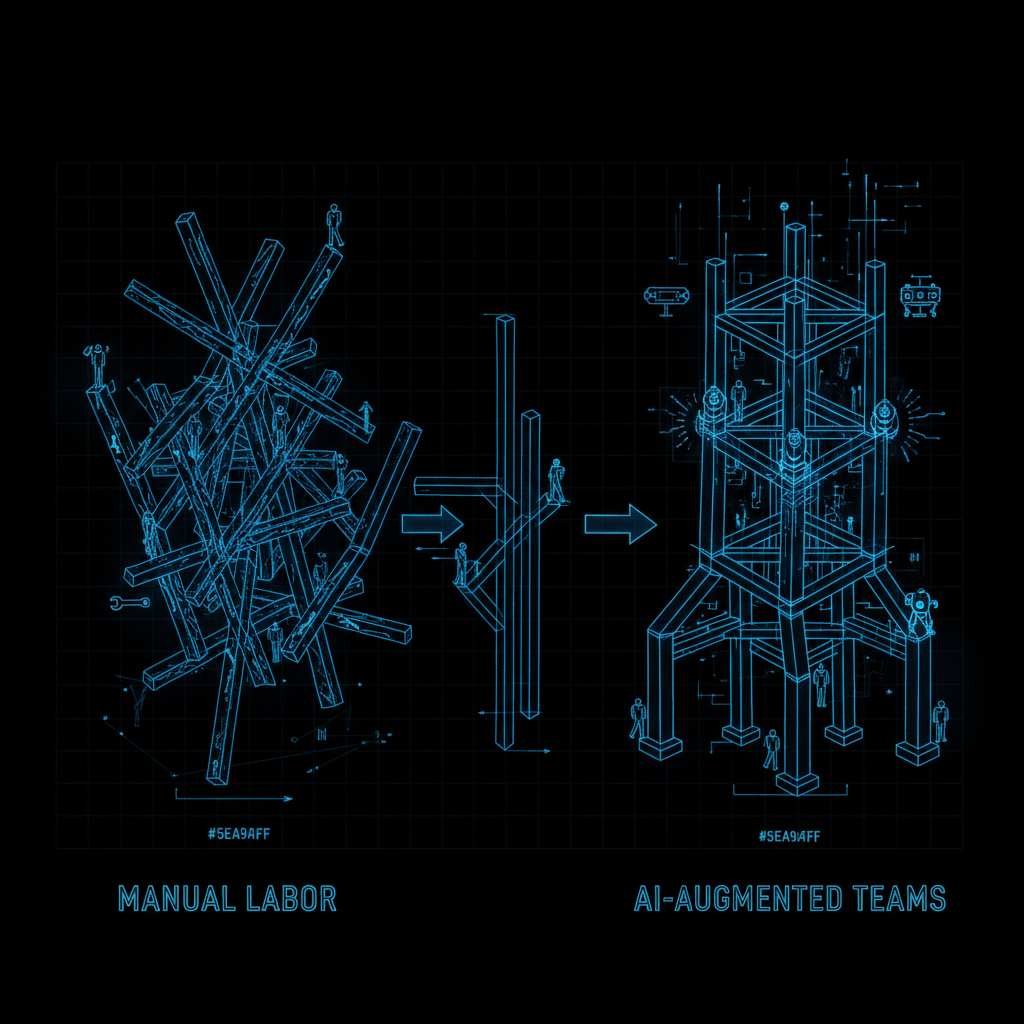
Unlike speculative technology shifts that promise revolution without fundamental need—remember the predictions about cities reorganizing around personal transportation devices?—the integration of AI into software development addresses a genuine economic imperative. Organizations face mounting pressure to reduce development costs while increasing software quality and user responsiveness. This creates the conditions for meaningful structural change in how teams operate and how systems are architected.
After evaluating several opportunities in the AI space, I’ve observed consistent patterns in how forward-thinking organizations are restructuring their development practices. The changes aren’t superficial—they represent fundamental rethinking of project dynamics, team composition, and architectural approaches.
The Economic Driver Behind AI Integration#
The market rewards efficiency, and in software development, labor costs dominate project budgets. For decades, the industry pursued productivity gains through better tooling, methodologies, and the elusive “10x developer.” AI assistance represents a different approach: augmenting entire teams rather than relying on exceptional individuals.
Companies that successfully integrate AI assistance into their development workflows gain substantial competitive advantages. Early movers are discovering that the bottleneck isn’t AI capability—it’s organizational structure and code architecture that either enables or prevents effective AI collaboration.
The Acceleration Pattern in Software Complexity#
Software development exhibits a well-documented pattern: tools and abstractions reduce complexity by approximately 3x every three years. This explains the persistent appeal of complete rewrites—yesterday’s complex system can often be rebuilt with today’s tools in a fraction of the original time and code.
However, delivery velocity hasn’t increased proportionally. Growing security requirements, compliance burdens, and organizational complexity have absorbed these productivity gains. The industry has adapted to a certain pace of delivery.
AI assistance disrupts this equilibrium. When teams learn to work effectively with AI, project timelines compress from months to weeks. This isn’t a marginal improvement—it’s a fundamental shift in what’s economically viable to build.
Structural Implications for Teams and Architecture#
This velocity increase forces architectural and organizational changes:
Project Decomposition: Work must be broken into chunks small enough for AI to process effectively. This pushes teams toward smaller, more focused modules and clearer interfaces between components.
Functional Programming Adoption: Paradigms that emphasize local reasoning and minimize side effects align better with current AI capabilities. Functional approaches let AI assistants understand and modify code without tracking complex state across large systems.
Incremental Delivery Requirements: Compressed timelines make incremental delivery mandatory rather than aspirational. Teams can’t spend months building features before getting user feedback—the economics don’t support it.
Human Role Evolution: Developer focus shifts from writing all code to architecting systems, validating AI-generated code, and ensuring business requirements are correctly implemented.
Object-oriented approaches may see reduced adoption until AI systems handle larger context windows and complex state management more effectively. In the interim, teams optimizing for AI collaboration will gravitate toward functional patterns.
Practical Implications for Development Organizations#
I’m observing several practical changes in organizations that are successfully integrating AI:
- Sprint planning now assumes AI assistance, with work estimates adjusted accordingly
- Code review processes include validation of AI-generated code patterns
- Architecture decisions explicitly consider “AI-friendliness” of different approaches
- Team composition includes roles focused on effective AI collaboration
- Technical debt that impedes AI assistance gets higher priority for refactoring
The organizations moving fastest aren’t treating AI as a productivity add-on—they’re restructuring around it as a fundamental capability.
Organizations that master AI collaboration will deliver software faster and cheaper. This means learning to work effectively with AI assistants, writing code amenable to AI modification, and architecting systems that AI can understand and extend. The economics make this inevitable.