Learning from Failed Experiments: The Path to Production AI Success
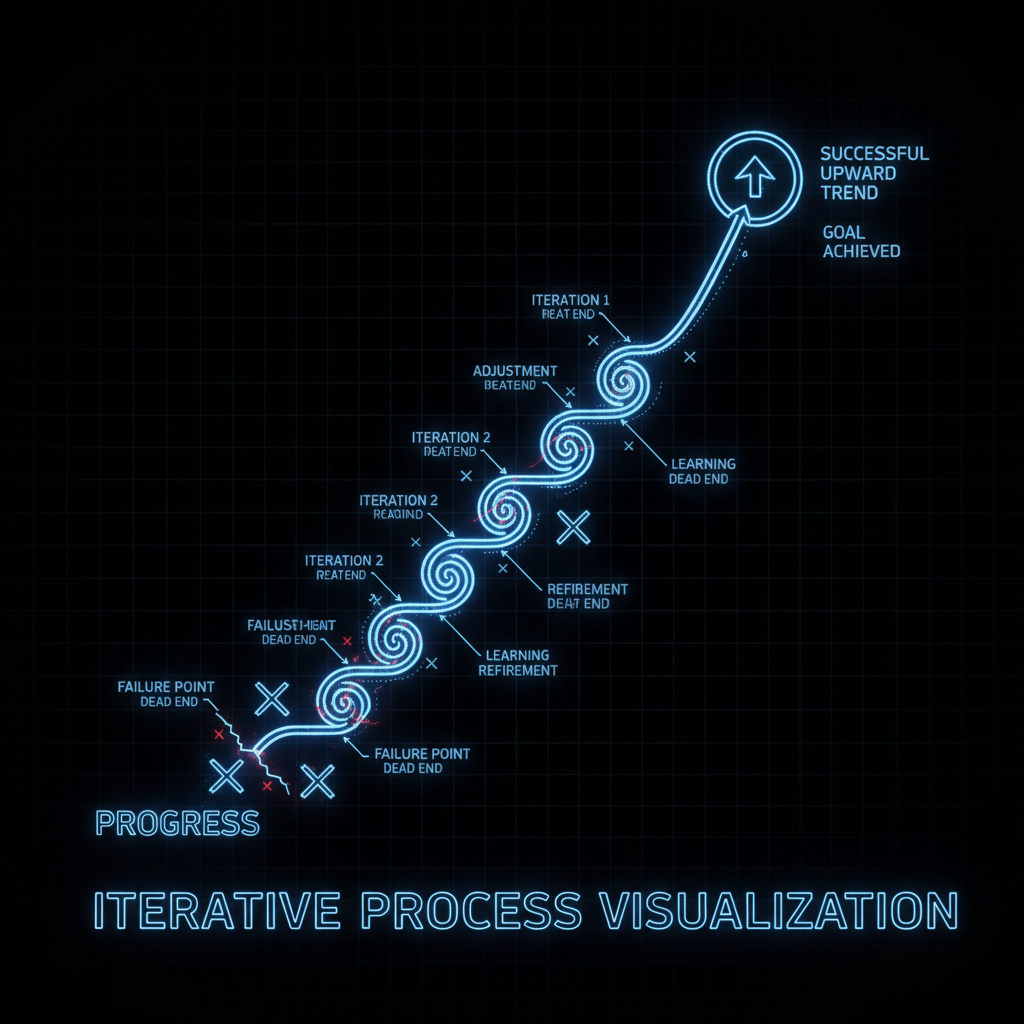
Our failures teach us more than our successes. The teams that excel aren’t those that avoid failure - they’re those that fail fast, learn systematically, and iterate relentlessly.
Reframing Failure in AI Development#
In traditional software, bugs are failures. In AI development, most experiments fail, and that’s not just acceptable - it’s essential. The key distinction is between:
- Productive failures: Experiments that conclusively prove an approach won’t work
- Wasteful failures: Repeated mistakes from not capturing lessons learned
- System failures: Production issues that impact users
Each requires different responses and offers different learning opportunities.
The Experiment-Failure-Learning Cycle#
Case Study: Recommendation System Evolution#
Our recommendation system’s journey illustrates the power of systematic failure:
Version 1.0: Collaborative Filtering (Failed)
- Hypothesis: User similarity drives preferences
- Result: 45% click-through rate (CTR)
- Failure: Cold start problem killed new user experience
- Learning: Need content-based features for new users
Version 2.0: Deep Learning Everything (Failed)
- Hypothesis: Neural networks will find optimal patterns
- Result: 52% CTR but 300ms latency
- Failure: Too slow for production requirements
- Learning: Performance constraints matter more than accuracy
Version 3.0: Hybrid Approach (Succeeded)
- Hypothesis: Combine simple models with selective deep learning
- Result: 68% CTR with 50ms latency
- Success: Met both accuracy and performance requirements
- Learning: Pragmatic solutions beat pure approaches
Version 4.0: Real-time Personalization (In Progress)
- Building on lessons from V1-3
- Early results: 71% CTR in A/B tests
Each “failure” provided critical insights that informed the next iteration.
Creating a Culture of Productive Failure#
1. Experiment Documentation#
We maintain an experiment registry that captures:
class ExperimentRecord:
    def __init__(self):
        self.hypothesis = ""         # What we believed
        self.approach = ""           # How we tested it
        self.metrics = {}           # Quantitative results
        self.duration = 0           # Time invested
        self.outcome = ""           # Success/Failure/Partial
        self.lessons = []           # Key takeaways
        self.next_steps = []        # What to try next

    def to_markdown(self):
        return f"""
## Experiment: {self.hypothesis}
**Date**: {datetime.now()}
**Duration**: {self.duration} days
**Outcome**: {self.outcome}

### Approach
{self.approach}

### Results
{json.dumps(self.metrics, indent=2)}

### Lessons Learned
{chr(10).join(f'- {lesson}' for lesson in self.lessons)}

### Next Steps
{chr(10).join(f'- {step}' for step in self.next_steps)}
"""
2. Failure Post-Mortems (Without Blame)#
When experiments fail, we conduct structured reviews:
## Post-Mortem: Feature Engineering Pipeline Failure

### What Happened
- New feature extraction code caused training to fail
- 3 days of GPU time wasted
- Delayed model update by 1 week

### Root Cause
- Inadequate validation of feature distributions
- No alerting on training anomalies
- Insufficient test coverage for edge cases

### What Went Well
- Team identified issue within 4 hours
- Rollback procedure worked perfectly
- No production impact

### Action Items
1. Add distribution validation to feature pipeline
2. Implement training anomaly detection
3. Increase test coverage to 90%
4. Create feature engineering checklist

### Lessons for Team
- Always validate data assumptions
- Monitor everything, especially during experiments
- Fast failure detection is more valuable than prevention
3. Celebrating Intelligent Failures#
We actively celebrate failures that prevent larger issues:
- “Fast Fail Award”: Monthly recognition for quickly identifying doomed approaches
- “Learning Champion”: Team member who extracts most insights from failures
- “Pivot Master”: Successfully changing direction based on failure signals
Technical Infrastructure for Failure Management#
Experiment Tracking System#
import mlflow
from typing import Dict, Any
import traceback

class ExperimentManager:
    def __init__(self, project_name: str):
        self.project = project_name
        mlflow.set_experiment(project_name)

    def run_experiment(self,
                       name: str,
                       hypothesis: str,
                       config: Dict[str, Any],
                       train_func: callable):
        """
        Safely run experiments with automatic failure handling
        """
        with mlflow.start_run(run_name=name) as run:
            mlflow.log_param("hypothesis", hypothesis)
            mlflow.log_params(config)

            try:
                # Run the experiment
                metrics = train_func(config)
                mlflow.log_metrics(metrics)
                mlflow.log_param("outcome", "success")

                return {"status": "success", "metrics": metrics}

            except Exception as e:
                # Log failure details
                mlflow.log_param("outcome", "failed")
                mlflow.log_param("error_type", type(e).__name__)
                mlflow.log_text(traceback.format_exc(), "error_trace.txt")

                # Extract learnings from failure
                learnings = self.analyze_failure(e, config)
                mlflow.log_dict(learnings, "failure_analysis.json")

                return {"status": "failed", "error": str(e), "learnings": learnings}

    def analyze_failure(self, error: Exception, config: Dict) -> Dict:
        """Extract learnings from failures"""
        analysis = {
            "error_type": type(error).__name__,
            "likely_cause": self.diagnose_error(error),
            "config_issues": self.check_config(config),
            "recommendations": self.suggest_fixes(error, config)
        }
        return analysis
Automated Failure Detection#
class FailureDetector:
    def __init__(self, thresholds: Dict[str, float]):
        self.thresholds = thresholds
        self.alert_channel = "#ml-experiments"

    def monitor_training(self, metrics_stream):
        """Detect failures early in training"""
        for step, metrics in enumerate(metrics_stream):
            # Check for NaN/Inf
            if np.isnan(metrics['loss']) or np.isinf(metrics['loss']):
                self.alert(f"Training diverged at step {step}")
                return "divergence"

            # Check for stuck training
            if step > 100 and metrics['loss'] > self.thresholds['initial_loss']:
                self.alert(f"No learning detected after {step} steps")
                return "no_learning"

            # Check for overfitting
            if metrics.get('val_loss', 0) > 2 * metrics['train_loss']:
                self.alert(f"Severe overfitting detected at step {step}")
                return "overfitting"

        return "completed"
Learning Patterns from Failures#
Common Failure Modes in AI Systems#
After analyzing hundreds of failed experiments, patterns emerge:
1. Data Quality Issues (40% of failures)#
# Preventive measures
def validate_dataset(df):
    checks = {
        'nulls': df.isnull().sum().sum() == 0,
        'duplicates': df.duplicated().sum() == 0,
        'distribution': scipy.stats.normaltest(df.select_dtypes(include=[np.number]))[1] > 0.05,
        'outliers': (np.abs(stats.zscore(df.select_dtypes(include=[np.number]))) < 3).all().all()
    }

    failures = [check for check, passed in checks.items() if not passed]
    if failures:
        raise DataQualityError(f"Failed checks: {failures}")
2. Overfitting (25% of failures)#
# Early stopping with patience
early_stopping = EarlyStopping(
    monitor='val_loss',
    patience=10,
    restore_best_weights=True,
    verbose=1
)

# Regularization strategies
model = build_model(
    dropout_rate=0.3,
    l2_penalty=0.01,
    batch_norm=True
)
3. Infrastructure Issues (20% of failures)#
# Resource monitoring
@contextmanager
def resource_monitor(experiment_name):
    start_memory = psutil.Process().memory_info().rss / 1024 / 1024
    start_time = time.time()

    try:
        yield
    finally:
        end_memory = psutil.Process().memory_info().rss / 1024 / 1024
        duration = time.time() - start_time

        if end_memory - start_memory > 10000:  # 10GB increase
            log_warning(f"{experiment_name} used {end_memory - start_memory}MB")
        if duration > 3600:  # 1 hour
            log_warning(f"{experiment_name} took {duration/3600:.1f} hours")
Turning Failures into Features#
Sometimes, understanding why something fails leads to breakthrough insights:
Example: The “Failed” Anomaly Detector#
We built an anomaly detector that had a 15% false positive rate - too high for production. Instead of discarding it, we analyzed the false positives and discovered they predicted user churn with 84% accuracy. The “failed” anomaly detector became our successful churn prediction model.
def analyze_false_positives(predictions, ground_truth, user_data):
    """
    Analyze what false positives might actually indicate
    """
    false_positives = (predictions == 1) & (ground_truth == 0)
    fp_users = user_data[false_positives]

    # Check if FPs correlate with other behaviors
    correlations = {
        'churned_within_30_days': fp_users['churned_30d'].mean(),
        'decreased_activity': fp_users['activity_decrease'].mean(),
        'support_tickets': fp_users['support_contacts'].mean()
    }

    # False positives might be true positives for different problem
    return correlations
Building Resilient Systems#
Graceful Degradation#
Design systems that fail gracefully:
class ModelServer:
    def __init__(self):
        self.primary_model = load_model('production_v2')
        self.fallback_model = load_model('production_v1')
        self.simple_baseline = SimpleHeuristic()

    def predict(self, request):
        try:
            # Try primary model
            return self.primary_model.predict(request)
        except Exception as e:
            log_error(f"Primary model failed: {e}")

            try:
                # Fall back to previous version
                return self.fallback_model.predict(request)
            except Exception as e2:
                log_error(f"Fallback model failed: {e2}")

                # Use simple heuristic as last resort
                return self.simple_baseline.predict(request)
Canary Deployments#
Test in production safely:
def canary_deployment(new_model, traffic_percentage=0.01):
    """
    Gradually roll out new model
    """
    results = {
        'new_model_metrics': [],
        'old_model_metrics': [],
        'errors': []
    }

    for request in request_stream:
        if random.random() < traffic_percentage:
            # Route to new model
            try:
                prediction = new_model.predict(request)
                results['new_model_metrics'].append(
                    measure_performance(prediction, request)
                )
            except Exception as e:
                results['errors'].append(e)
                prediction = old_model.predict(request)
        else:
            prediction = old_model.predict(request)

        if len(results['errors']) > ERROR_THRESHOLD:
            rollback()
            break

    return results
Metrics for Learning Culture#
Track how well your team learns from failures:
class LearningMetrics:
    def calculate_team_learning_rate(self):
        metrics = {
            'experiment_velocity': experiments_per_week,
            'failure_recovery_time': mean_time_to_recovery,
            'lesson_application_rate': lessons_applied / lessons_documented,
            'repeat_failure_rate': repeated_failures / total_failures,
            'innovation_index': novel_approaches / total_experiments
        }
        return metrics

    def learning_efficiency_score(self):
        """
        Higher score = better at learning from failures
        """
        score = (
            self.lesson_application_rate * 0.3 +
            (1 - self.repeat_failure_rate) * 0.3 +
            self.innovation_index * 0.2 +
            min(self.experiment_velocity / 10, 1) * 0.2
        )
        return score
Related Practices#
Learning from failures connects to broader development practices. XP 3.0 emphasizes TDD as guardrails for AI-generated code - catching failures early before they reach production. Strategic prioritization helps teams focus on high-value experiments, reducing wasteful failures while embracing productive ones.
The teams that ship successful AI products:
- Fail fast and cheap through rapid experimentation
- Document failures systematically to extract maximum learning
- Celebrate intelligent failures that prevent larger issues
- Build infrastructure that expects and handles failures gracefully
- Create culture where failure is seen as data, not defeat
Every failed experiment narrows the search space for success. Every production issue teaches about real-world constraints. Every mistaken hypothesis refines understanding.